Though I’m an only child, mom has one sibling, an older sister by only 15 months. She is quite often there for us in many ways and her kids felt like older siblings while I was growing up. Dad has 6 siblings, all younger than he, 4 still living and the living aunts are the lifeblood of the family, arranging the remaining gatherings and stepping up in many ways to provide encouragement and to handle quite a bit. In Dad’s family two of his sisters were nurses and a brother was a pharmacist. Those in my family that work or have worked in the medical field make me believe in and hope for the excellence that could be; and they help me to know that that excellence does exist when systems that work meet effort on the part of the individual serving or treating the patient or training and working with the family.
My in-laws are blessed with 3 siblings each and though all branches of our family have experienced losses, both my father-in-law and mother-in-law still have all 3 siblings each. I appreciated seeing big families on both sides in my husband’s life when I met him and married him and though nothing is perfect we have all been blessed by having the privilege to know and spend time with so many family members.
There have been some reunions with some of the families over the years and I love to be part of them. However, I see how much time, energy, and effort goes into hosting and bringing everyone together so it’s rarely possible. But yet the time together is sweet and truly life-giving when it happens.
A good friend of mine is sandwiched right now and if I told you how many of her own incredible children she and her husband are raising in 2025 you might not believe me. But she is caring for her mother-in-law while mothering her own children and pretty recently cared for her father-in-law as well in the most selfless manner. We were chatting this week about a few of the latest challenges for each of us and I mentioned that it must be very challenging for her and her husband to care for their own home while also caring for her mother-in-law’s home nearby and just acknowledging that I see how much they have taken on with such a willingness to serve and show compassion and to show their kids what it looks like to serve family. I mentioned that I am very grateful that my parents were willing to move in with our family and combine our homes into one home. It makes it far easier to manage one home and to provide care and transportation to appointments and meals and interact with home health from one home base. And I am certainly grateful that heading back to bed in my own home is only steps away from where I run to if they need me. My friend and I talked about how much easier it is to do this because I am an only child and there are no other children, children-in-law, or grandchildren for my parents to consider, to host, to allow a seat at the decision-making table. While the advocating alone is tough, not to mention managing the phone calls and appointments and medications and diet specifications and more, it’s a bit of a blessing in disguise that I don’t have to involve anyone else as we might not be on the same page and that could certainly add another layer of challenges.
This reality will certainly warrant a number of posts to do it justice, but I wanted to acknowledge hearing some compassion fatigue from some of the medical professionals we have interacted with lately. I know it’s epidemic at this point due to so very many relevant factors and that everyone must have heard of it by now. However, I am wondering if we are seeking to find adequate solutions.
So I have experienced Compassion Fatigue at times in my work as well as in my personal life as a sandwiched adult with both the top and bottom bread in the same household with me. And I heard it last week in the voice of the case worker in charge of the ED at the big hospital when I called upon her to assist me with getting Mom discharged from the ED before we reached the second midnight.
For me personally as the daughter of a patient who has been in and out of the hospital every few weeks or less starting exactly 8 months ago today, it’s been, and continues to be quite the journey. Last week when I realized we could pick Mom up while she was still under the care of the ED in time for her not to lose the 3 weeks she put together at home (now she has 4!) I was making some pretty passionate phone calls advocating for this to happen. I was calling from a noisy place and ended up in tears while explaining everything to the ED’s case worker after already explaining it all to the Utilization Review Specialist and the bedside nurse. I just began to cry from a place of overwhelm and from that place of daring to hope while also managing those expectations. The case worker sounded cold and matter-of-fact. She helped, but it felt very clear to me that she had heard too many crocodile tears in her time and did not hear mine as any different.
Today I was chatting with someone who is a close friend of mine who is a provider who worked many years ago in an ED far away from here. This person still works in the medical field, but the day to day is very different these days. And this friend shared that there probably are more genuine individuals such as myself who really have been through a lot with their loved ones and truly do need more empathy than we are getting. However, this individual shared something said frequently in the past during a time when there was quite a bit of med-seeking, exaggerated symptoms, and other manipulation on the part of patients in this person’s work life, coming into that ED back then. “I must have left my compassion at home on the kitchen table.” And before anyone judges this individual who is an excellent provider and has a lot of compassion for true needs, I put this here as something for us to think about. I have challenged providers who have not taken care to do their jobs well. I have elevated some concerns to supervisors during these last 8 months and I continue to do so because all of the patients, especially those who have no one to advocate for them deserve ongoing improvements to their care. But I want us all to take some time to think about what medical staff deal with each day and how those experiences accumulate and pile on and can lead to Burnout and to Compassion Fatigue.
May it become easier and easier and more and more affordable for those caring for others to get the support they need from mental healthcare to respite care to case workers who explain important concepts to patients and families effectively. When life gives them lemons, may they be able to cry into something other than the hospital tissues and find a way to recharge so that they may continue to provide the level of care and compassion that their jobs require. And may we as the caregivers and advocates recharge effectively as well.
Today’s advice is to write down the first and last name (or at least the last name) and title of the medical professional you are speaking with by phone, in person, or on speaker through the cell phone of your loved one who gets you on the phone just in time before the provider leaves the hospital room (something we learned to do often over these last nearly 8 months). You never know when you will need to contact that individual again, share their name with someone else, or report something that happened. These days I am grateful the notes I’ve kept are good. but I wish I had documented more, especially the names and titles of the various individuals who have communicated information to us along the way.
A sort of outpatient RN case manager from the small hospital system, who has been wonderful, called to follow up again today for the last time, but assured me that I can call her back if Mom needs something. She has been great, but I’m still unclear on how we got her managing things, encouraging me by phone, and determining what Mom needs in terms of case management these days. When I asked her upon first speaking with her (or maybe it was our second call) what her title is she said something about that being complicated. She has been relatable and warm and the helpful advocate for the patient (Mom) and caregiver (myself) that I wish we would have had from the beginning, and yet I feel a little strange about how supportive she was because her warmth and support led me to forget to keep asking her title. Maybe I’ll ask if I end up needing to call back. Why do I need to know? I don’t, but I am curious why we get this nurse following up closely and being so accommodating. I wonder what other patients get and what qualifies a patient for the helpful follow-up and from whom?
What you don’t think to ask while living the sandwiched life can lead to plenty of extra time calling in to clarify. Plan to budget extra time into your day, although there’s no way to predict how much time or when you’ll need it.
So I did receive a call back later yesterday afternoon in response to my call asking about whether Mom needs bloodwork this week so I could respond to the mobile lab and make their schedule. I explained the whole situation again and asked my questions again because it was clear that the person who works with the surgical team who called me (I believe she is a PA who has answered my questions in the past). So I explained again that when Mom was discharged 4 weeks ago from the big hospital, the discharge instructions asked us to take her for bloodwork every 2 weeks to help determine when she is nutritionally sound for surgery. I shared that I took her to the lab two weeks later for bloodwork and the same week home health from the small hospital said they could set us up with the mobile lab to come take care of these blood draws at home every 2 weeks. I then explained that Mom spent one midnight in the ED at the big hospital 3 weeks after her previous discharge and during that setback her blood was drawn before 2 weeks could pass again. I then shared that in our efforts to bring her home before two midnights had passed I never asked if she should have the next bloodwork done two weeks after the last outpatient bloodwork because maybe the orders in the ED were not the same and did not cover everything. I never asked if the next bloodwork should be one or two weeks after she entered the ED or one or two weeks after she was discharged from the ED or at another or with a different frequency. I pointed out that Mom’s first appointment with the big hospital’s outpatient surgery office is coming up next week, giving the date, and asked how many times they want us to get the assigned bloodwork prior to that appointment.
I asked all of that probably because I am Both overthinking the situation AND Also because it’s been a long journey and clarifying communication can truly be the key to smoothing over the next steps in the process. The reason I am telling you all about this is because you cannot make this stuff up; when advocating for your loved one at home after hospital discharge and while awaiting the next appointment, legitimate questions do arise and unfortunately there is rarely a simple process for getting a clear answer.
So she did not have an answer. She did encourage me a little by stating that the surgeon on duty in the outpatient office next week when Mom has her appointment is the same surgeon who admitted her to the big hospital and who initially diagnosed her there and began discussing future surgery this summer. However, she had no answer about the bloodwork and though she offered to check with the surgeon and let us know, she stated that she did not think it needs to be done now. Well, that’s a partial answer, but not clear direction 3 phone calls later.
I managed to forget to call the mobile lab back and they called again this morning while I was meeting with an online client. When I called back they agreed to put Mom on their schedule for next week and we are going to touch base if I hear more of an answer.
Trust me, there’s more to it than accompanying your loved one to all of the appointments that you schedule, reading all of the discharge and care instructions, and making/taking all kinds of phone calls, there are also all of the questions you did not get an answer to, mostly because you didn’t think to ask at the time.
Clear your schedule (yeah, LOL). There’s plenty to do to clarify what the plan is between appointments and to prepare for the next appointment. And now the kids are home from school or you’re driving them to camps. Controlled (or not) chaos and here’s yet another call to make and another one’s coming through. And those who have time to talk with you don’t know the answers, but maybe they will get them. Hopefully not having the answer doesn’t matter when it comes to making progress toward further treatment goals.
So this morning my mom got up at 5:30 AM (and she is not a morning person) to be ready and in the car for me to take her to an echocardiogram at the small hospital’s outpatient cardiac center. It was a quick check up precaution as a surgeon nicked her in early February and her BP tanked to 40 and she experienced ischemia. We were told the ischemia was likely to not cause permanent damage, but we also hope the big hospital’s surgeons will operate on her in August to remove the rest of the scar tissue inside that seems to be causing the repeated blockages so an updated echo is helpful for that as well.
Anytime I take Mom to an appointment we need to get her into her older, small car because she is unable to get into our SUVs because of how high they are. She’s 5 feet half an inch tall and has bone on bone knees (updated xray last week confirmed that they are some of the worst the orthopedic surgeon has seen and that they both need to be replace which we knew) so getting her in the car is a whole thing. Then getting the wheelchair once we arrive and getting her out and into the wheelchair is a whole other thing, so we leave plenty of time.
The echo involved an upper body change into a gown and then getting mom up onto a hospital bed. Things were going well until the technician administering the echo made a big announcement to us that she would be putting in an IV for contrast to get better pictures of a certain area. It was unexpected because outside of the hospital setting we don’t remember Mom getting an IV outpatient or having to have the contrast for an echo (at least not outpatient) so that was a little unsettling/surprising, but we took a deep breath and nodded along. Well Mom has become somewhat of a tough stick and the technician tried several times to find a vein that would be suitable to put in the IV and add the contrast. When after several tries she simply said never mind, that she would take a few more images and it is probably good enough and she does not want to hurt my mom, “well ok” I said, “But are the images with the contrast needed? If so, should we go over to the hospital where there is an IV team to get them?” Her response was that it is a Monday morning and the hospital is not an option for us.
I am not condemning her in any way. I am glad she stopped sticking Mom while she was ahead, when she recognized her own limits and the limits of the situation, but why isn’t there a backup for situations like this? Can we have a nursing supervisor who is IV team certified to get that IV in so we can take the images while we are here? Mom cannot possibly be the only outpatient echo patient who is a tough stick. Where’s the back up? Also, Mom’s test results came back as suspected, very few issues (just monitoring needed), but I am left wondering if they missed something because we didn’t do the contrast. I am trying to pick my battles with the small hospital because they are the closest to our home; it’s our family’s local hospital, but seriously, where is the clear communication about why she needed that contrast? To get a better image of what?
If I had pushed, would she, as a technician, have been able to give us more info? Often they are vague because they are not the provider. We’ll wait for now to have the provider’s office call us with the results and advise us. And again, we definitely were not looking for unnecessary sticking but we came here, after quite the process, and got Mom on the table. Can we get the job done? Is it never mind, you don’t need it? Or will we be called back in, adding more to my schedule (which already feels like the puzzle of the century) and more discomfort to Mom to get back to the facility and back on the table for another test?
Hopefully they have what they need, but you simply cannot make this up. Dear small hospital, please get your staff the back up they need and train them to communicate what is necessary and helpful in a way that gives the patient and family a true picture of what is going on, why we are taking these steps, and what the next steps are.
Since then later this morning I received a call from the mobile lab about coming tomorrow to do the every two week blood draw that the big hospital wants before Mom goes to her outpatient appointment with those surgeons next week. We went to the lab for the first blood draw with the little paper prescription two weeks ago on Tuesday. The amazing home health nurse listened and found out that it’s tough to get Mom to the lab every 2 weeks and since Mom has home health she got us set up with the mobile lab and they called right on time to come 2 weeks after what they believed was the last known blood draw as planned. However, Mom’s setback last week brought her to the big hospital’s ED on Tuesday and thankfully we picked her up from the ED Wednesday. However, blood was drawn during that time, so this morning I realized that maybe we don’t need to have blood drawn tomorrow, maybe it’s to be 2 weeks from when she last had it drawn at the big hospital. So I wrote down the mobile lab’s phone number (thankful I didn’t forget to do that), then called the number associated with Mom’s surgical outpatient appointment next week (waited on hold, pressed the right number after listening to a list of possibilities, and then was told that I needed to be transferred to a voicemail for the nurses for this practice and they would get back to me). There does not appear to be a simple way to find the answer to a fairly simple question.
And to add to it- I spent 28 minutes on the phone today with the small hospital system’s pediatric office to schedule my four children’s wellness visits. That was a whole thing because our insurance told me in the past that our children can have more than one wellness visit in a year because sometimes scheduling works best right before a year has passed before the last visit occurred. My understanding is that that is a rare privilege to have that coverage. Nothing has changed with our coverage, but the office is now telling me that even though you can have more than one in a calendar year, so you can schedule before it’s been a year since the last appointment, you have to schedule only one visit while your child is a certain age, so you have to make sure the next visit is after their next birthday. I asked if he was sure that this was confirmed and he told me he cannot confirm anything and I need to call the number on the back of my insurance card. Not wanting to have to bother calling (because I know I did that a few years ago and at that time the insurance company confirmed that I could schedule more than one wellness visit in a year), I scheduled the appointments so that each child will have turned the next age just prior to each next appointment. I know for a fact that Many have it worse. There’s gotta be better processes for us all. SMH.
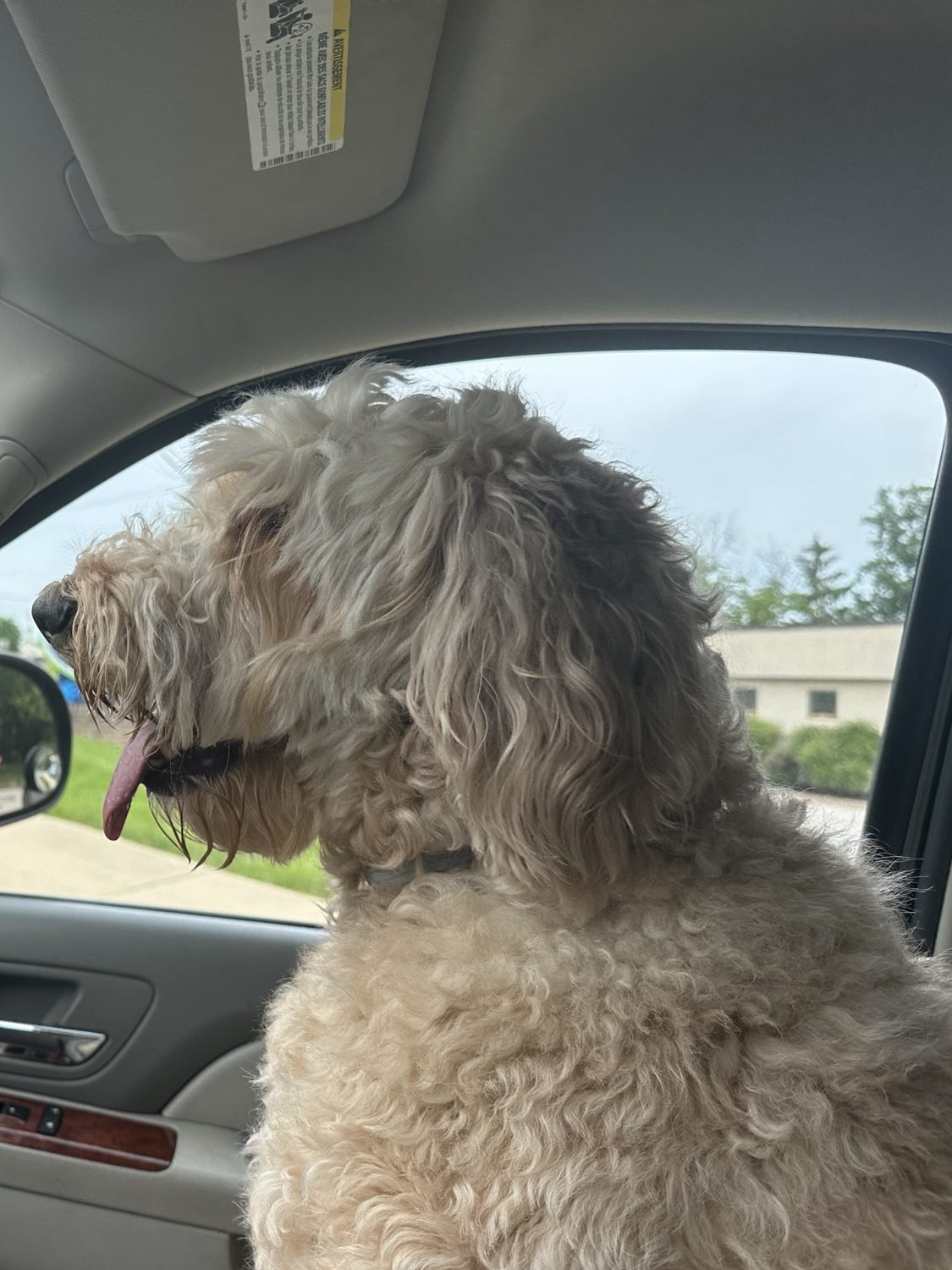
Each time Mom’s discharge from a hospital is being planned they ask her who she has at home. She is always very pleased to share about her 4 grandchildren, son-in-law, daughter, and husband (I think in that order), but the one bonus that brings an extra smile to her face is our golden doodle. She loves our dog and our dog loves all of us so well.
She’s the one who welcomes Mom home by parking herself right beside her or behind her wheelchair. She is loyal and loves with all of her heart and sloppy kisses. She thinks everyone is here to see her and jumps up on them to greet them. We put her out back when home health and new friends arrive until they get to know each other.
She’s the one everyone loves to sit with and the one everyone loves to complain about when she makes a mess. We rarely feel lonely in such a full house, but with her around it’s impossible to find yourself completely alone unless she’s on the other side of a door from you.
She loves to play and go for walks and put herself right next to one of her favorite humans and create a snuggle sandwich. She got a clean bill of health recently and for that we are thankful. Trips to the vet with her are lively as can be and nearly always threaten to knock me over. This last time I was encouraged to purchase some kind of harness because the leash is not really doing the trick.
Seeing her throw herself into each exciting moment with all four paws is really something to experience as is getting to pet her soft hair that does not shed. A perfect match this our high demand, high maintenance era.
While sandwiched it’s wise to ask for help if you can. Or to hire help if you can. Or to sometimes squeeze a little support out of those you are supporting. I haven’t had a lot of choices in this department for the big things. As an only child, unless my husband feels like stepping in (especially when it comes to medical advocacy for my parents) it’s me. No one to volley to. I am, however, blessed with medical professionals on both sides of my extended family and among friends who are only a text or call away and have been absolutely invaluable primarily from a distance. But basically when it comes to certain things, it absolutely is me and only me.
With the kids there are more takers. My in-laws have had them often and even my parents can and will still do what they can. Dad helps with some of the morning and afternoon routines and one incredibly significant help my Mom provides, even when she is not feeling great, is securing my daughter’s hair in whatever style has been assigned for her dance performance. Securing bobby pins in a style just right is not in my wheelhouse. Never before have I heard more about how I should hire people to do more for us. Um, that’s quite complicated when it’s just not affordable or when tough choices would have to be made in order to sub something out. There are some things that are tough to sacrifice, especially when we work as hard as we do, volunteer, care give. advocate, and taxi everyone around while bringing the fan club energy.
At the times when I cannot get help I keep going because it has to get done. I try to hydrate, caffeinate, increase protein, and give myself little breaks when it works. But it is honestly the case that sometimes So much is back to back and nothing is as expected and it’s just one thing after another without the opportunity for a break. In these trying times I am asking myself, “Does it have to be me?”
Sometimes it’s simply an annoying choice of whether or not we are going to miss out because I cannot be in multiple places at once and my husband is working or he is declining to help because it is not something he values (usually something fun with the kids that costs money). Other times we are all driving kids around at once, including my in-laws. And yet other times, I am driving 5 minutes home to catch up on work notes because three of my family members are already volunteering at the event we ran this week for kiddos and I have already done my part. The guilt sets in, questioning whether I should stay until the end, but it is all running like a well-oiled machine and I am able to step back and get something accomplished in a quiet house for a short time.
There are volunteer commitments I am seriously thinking of bowing out of because others can and they may not if I don’t step aside and leave it to them. There is so much I want to do but the sleep deprivation is catching up and I am not close to bringing my best to my family and loved ones when I am hanging by a thread. So often there is no rest for the weary, especially caregivers, but other times there are possible escapes, possibly ways to pass on something or pass something on.
If you can, hand it over to another willing supporter. If not, consider if it’s something that, if dropped, will not necessarily lead to significant long-term issues. Sometimes when you stop filling a need, someone else steps in that would not have.
And sometimes you just have to step away while everything’s ok. Close the laptop and go get some sleep. Turn around and exit in order to wrap up some work tasks. Take a couple of hours to go do anything you feel like doing while all is stable and everyone is occupied.
It’s fine until it’s not and when there is some flexibility in terms of who can take care of it, try not to have it be you again. Aiming for self-care is a whole other level of complicated, here we are aiming for some self-preservation by doing what is needed and ducking out when you were expected, but someone else can and will pick up the slack if you don’t.
This week’s posts have been about overload and that’s such a significant part of the Sandwich generation, but today I want to highlight a stand out experience with the hospital system this week that I truly hope can help others better advocate for their loved ones.
We got to work with the Medicare 2 midnights rule for the first time this week with Mom. We are learning to find our way with very little guidance through a system that seems to be the furthest from user friendly. Let me be your guide as you prepare to support your loved ones in the future!
Long story short this time it was a large blockage much further down than recently and I just don’t know how that happened because she’s been on a liquid diet. The surgeons said earlier yesterday that they could admit her to an observation area of the ED and get her bowel regimen figured out, but that they are still not going to operate at this time and the plan remains the same (go home on liquid diet and await elective surgery probably in August).
BUT I didn’t realize (and THANK GOODNESS my husband understands this insurance stuff better than I do and was paying attention), that she was STILL in the ED last evening and it had only been ONE MIDNIGHT! I talked to a Utlization Review expert who works for the big hospital and she confirmed (which my husband suspected) that if we picked her up before midnight last night, which we did, it’s before the “two midnights rule” so then she DOESN’T lose her 3 weeks at home!!!!!!!
Let me explain- Mom’s Medicare plan has a certain number of inpatient stay days. These days covered her many inpatient hospitalizations and also were used anytime she was in an intensive rehab instead of going directly home from the hospital with home health or instead of going to a skilled nursing facility for rehab (this is billed out of a different “bucket” of Medicare funds). We knew very little and along the way one of the small hospital’s staff members (I believe a social worker, but I have no idea who it was) told me that inpatient days were unlimited so I fought hard for Mom to stay admitted through an infection and unexplained pain and several stretches of time when she was unable to eat. If I had known we were burning through limited days I would have handled things differently. She certainly should have been in the hospital during those times, but it’s clear that we cannot always get and maintain the care that is needed for as long as it is needed. There are definitely limits. I also was under the impression that the intensive rehabs were paid from the same bucket of as the skilled nursing facilities. I also spent an hour and 20 minutes one day not long ago on the phone directly with Medicare during this journey and was given completely wrong information after a long conversation where I asked very specific questions, sharing my knowledge and Literally having someone who works for Medicare stating the complete wrong thing about my Mom’s plan and which parts of Medicare pay for each level of care. Because she used so many inpatient days or days that count as inpatient (part of this was after a surgeon nicked her and she had to go on a wound vac, prolonging her inpatient stay days) she is now well into what are her 60 lifetime days for inpatient and once those are gone, they are gone. The other days will re-up every time she is able to be home for 60 days straight. Being in a skilled nursing center for rehab, while out of the hospital does not count as being home. So even though she had no readmits for more than 20 day while in her second skilled nursing facility for rehab, none of those out of hospital days counted toward the 60 at-home days she needs to put together for her inpatient days to re-up.
So yesterday I figured this out at like 4:20 PM when my husband re-explained it (we’ve never been able to discharge ahead of the two midnights while still in an ED before) so I started frantically calling the staff at the big hospital, and after talking with like 5 people I got my message across and I spoke to the surgical team and they said if she ate her liquid dinner without any problems they would check on her after dinner. It worked out and my husband and I were able to go get her. She was still on Medicare Part B so we are still on 3 weeks at home and counting as we try to get to 60 days straight at home for Medicare A benefits to re-up. Shout out to my mom’s AMAZING first shift nurse yesterday in the ED who sprung into action when I called and got us Everyone’s attention that we needed to get her out and home in time. Now we wait and hope again and it looks like home health can restart pretty seamlessly!
While Sandwiched it can feel like an endless spinning hamster wheel set to Hot Mess Express.
It’s summer and Mom ended up in the ED again yesterday at the large hospital, first time through the ED there with yet another blockage. 3 days to the day after being discharged from her direct hospital to hospital admit. It’s getting close to 8 months since we began this round of revolving door hospitalizations. Dad ditched his golf game to get Mom there because we are 45 minutes away and we are done letting the ambulance take her to the small hospital if we can avoid it. A tiny win was that Dad spent the night in the ED for the team this time. Mom has had a lot of therapy and has lost a bunch of extra pounds (not the healthy way) and as a result she is stronger in some ways and they just saw her there 3 weeks ago so I was able to :sit” this one out. One tiny win is that I could wake up around 7 AM instead of the usual 6 AM because there’s no school bus to miss right now and my role as the family uber driver wasn’t scheduled to leave the driveway until after 8 AM. So I let my feet hit the floor after Mom’s call came through at 6:45 AM, obediently placing me on speaker on her cell phone which is really the only way I get to speak with any member of the surgical team. This resident told me she’d call me. She didn’t. So I was up!
So of course “but first coffee” and then I got an Urgent email from the organizer of my youngest’s camp deciding to start it a half hour late to avoid the rain, meanwhile it said in the email confirmation to wear sneakers instead of cleats so they could go inside in case of rain. Why complain? But actually I ended up having to spend my own bathroom time “urgently” texting my hairapist whose child also attends the camp asking for a favor. Fellow moms in your village are non-negotiable when you’re on the Hot Mess Express. And casting a wide net to expand and grow that village can keep you from being flung from hamster wheel most days. She immediately agreed to drive my youngest to camp since I could not do 9 AM drop off at two camp locations simultaneously and, as he is able to do most mornings, my husband peaced-out early with a spring in his step following the yellow brick road of his routine to the land of locked-in productivity where only adults interrupt you (sometimes he helps when he works from home, often he is involved when not working, and in his defense he works full-time and is the primary provider…but his privileges are different…he steps off the hamster wheel Often….and one could debate whether he really ever has experienced being on it at all).
My village grows often and the fellow moms (and some others) in it are incredible. Yesterday I forgot the shin guards and today I forgot a key piece of sports equipment and a Super Mama who I texted the camp flyer too, but didn’t know she had signed up, showed right up and handed my child just what was needed no strings attached. Another Super Mama texted me all about it as I pulled into the garage and laid eyes on the one I had forgotten to send along. Spent a few minutes sending the love and gratitude and feeling it.
Short-lived….thought I might get some work notes done. Sent an email. Spent time on the phone with the hospital and answering calls from other medical providers’ offices. Spent time sorting through piles with my saint of a cleaning person because we were alone in the house with no one but the phone to interrupt and she knows I am buried in everything I have to deal with and she’s younger and taller and does not get winded taking a million trips up and down our staircases and doesn’t need a stool to reach my kids’ highest closet racks. We made a dent and she brings the enthusiasm for organization. I apologize profusely for the mess and truthfully assert that I would rather facilitate a room full of people in crisis than sort (and especially than donate) the things. Right now we can only afford for her to clean sections of the house during her few hours each week OR to have her help me organize. Not both. Not more. But we know how incredibly privileged that makes us. To have anyone….a village volunteer or a treasured hired helper…is more than so many of the Sandwiched get. I get it. But I know I don’t really get it, not everyone’s experience I don’t. We worked for all of camp and my husband couldn’t even tell what I had gotten done. But I saw it.
Back to find my youngest beaming and chattering about all the fun she had at camp and all of the great coaches and friends and I got a chance to be the village for 5 minutes hanging out with the child of my hairapist when she was 5 minutes behind and the high schooler camp helpers jetted as quickly as they could. It was a tiny privilege to stand with her daughter as they all stood around for me for 17 minutes the day before while I tried to get from one camp to another. Today my Super Mom-in-Law was previously scheduled to run kids to and from camp while I drove Mom to an outpatient appointment near the big hospital. That fell off the list as Mom was lifted into the hospital bed, but Super Mom-in-Law was still willing to pick up the oldest 3 from camp at the same exact time when I had to be there to pick up my youngest, gave her a packed lunch in the car, and drove her to the loving home of one of my Bestie Super Mamas who kept her all afternoon while I met with clients online and she then took my youngest to a rehearsal that her kiddos also participate in and we all ended the day this week as volunteers at an evening kids’ event (which thankfully includes dinner this week made by more parents from the village). Tomorrow she will drop off her crew and I will entertain, feed em, and mom lyft to rehearsal and then to the kiddo event. How do others who are Sandwiched manage if there is no village?
Couple clients canceled and I was able to make calls, answer emails, and manage to start a series of calls I had to make to secure Mom’s discharge from the large hospital tonight before two midnights had passed (future blog post about the two midnights and playing the Medicare game). The surgeons want her stronger before elective surgery and are not going to operate even though she is very uncomfortable because it’s not emergent again yet. She received the treatment she was going to get to stabilize her and was still being observed in a section of the ED so we could bring her home to continue on her liquid diet and await elective surgery before digging into more of her limited lifetime Medicare days. She is about out of inpatient Medicare days because she hasn’t been home for 60 straight days in almost 8 months. Some days were spent at the skilled nursing level of care (comes out of a different Medicare payment bucket) but most were in the inpatient hospital or at intensive rehab facilities (which count as being in an inpatient hospital). Because we left the kiddo event a little early and my in-laws brought the kids home in our vehicle so there were enough seats for our crew, and picked her up before the second midnight from the ED at the large hospital, she did not lose her 3 weeks she has put together at home. We do not have to start over again counting from the beginning. And we are jogging along toward that 60 day at home mark when many of her Medicare days re-up. What a system.
Settled Mom with Dad after a fairly smooth lap around another discharge, set off the load of wash I began loading into the washer yesterday and pulled up a chair to blog it out. Now maybe I’ll cut into the little sleep I rarely get enough of to watch a favorite show and feel like I am just me for a little while. Maybe someone who needs me will wake me up. Maybe I should fall right to sleep in case that happens. Maybe I don’t care because I want to watch my show a little bit because when running on the hamster wheel set to hot mess express while Sandwiched is a real trip and I can’t seem to Stop the Ride even though I want to get off.
The sandwich generation’s primary caregivers live in a series of these. We often find ourselves in a no-win situation.
Some recent ones for me include spending a bunch of time lining up summer camps that all 4 of my kids can go to for parts of the day so that we are not spending too much on full-day camps that we cannot afford because I only work part-time because I can’t work full-time and pay someone enough to do all the things I try and fail to do in a day. So I spend time I don’t have finding and registering for camps that might interest my kids of varying ages. For 3 days of this week we found one semi-affordable half day camp that would teach my oldest, second, and third child simultaneously while my youngest attends a separate camp with friends. I used time I didn’t have while paperwork for work is overdue so that I could gain some quiet time to catch up on my paperwork.
After two drop-offs, one with the leader showing up late, I hurried home to lock in with my paperwork. Dad moved his golf day from tomorrow to today because it will rain tomorrow. I want him less stressed and as healthy as he can be, but that meant I had to let the home health OT in. Home health is to free me up to do my work, but she parked me out of my driveway, offered to move while she hung on the phone and eventually came inside. No locking in for me. After I overheard her talking to my mom about discharge I got up and had one of many conversations for clarification and education. Then I got Mom her water and checked if she needed anything else while explaining that my job needs my notes done and I need to do them while the house is quiet. Got one note done before Mom started texting and calling me with her needs. In less than 3 hours’ paid time I had to rush out stressed as can be to two camp pick ups because I got practically nothing done again except for all of what feels like thankless labor for which I am the default family member. Mom’s calling me while I am trying to drive, my kids are screaming and fighting with one another when they’ve only been in the car 3 minutes. I completely lose my patience with them, I get home and work all afternoon with online clients while my kids fend for themselves under the supervision of my teen and preteen because there’s no more money for camp. And there would not have been any money for camp or the vacation we are going to take if I did not see those clients.
And I want to meet with the clients. After my family, the work I do with my clients is the greatest honor of my life. But if I didn’t work I would be able to give more attention to the generations around me and might do so with less rush, less stress. But I’ve been there, when I do that a light in me dims and threatens to go out. I miss work when I don’t work. And when I have too much work and cannot be there for family in the major things from advocating medically to being there for the school events and making sure they get to participate in the activities they want to be part of, it doesn’t feel right either. And if there’s no work there’s no money for the extras that we enjoy together. But it feels like I am always presented with no really good choices. If I spend the time on the holidays and the parties and the activities, the laundry and the clutter threaten to choke the life out of my home and this is close to the current reality. If I delegate, which I am blessed to do with the housecleaning, there are many questions about how many hours I need to fit in at work to cover it.
If I am the one who sits in the ED with Mom to advocate and the doctors do nothing major all night and then I am exhausted all day, no one is taking over with the kids and the laundry and the paperwork for work. If Dad goes and sits there we might risk he and Mom forgetting to verbalize an important detail. If I get home health I have to let them in and wonder when they are coming, with outpatient appointments for Mom I can schedule them but have to clear my morning or afternoon to be the one to take her. If I work or care for the family the chores do not get done.
Still not sure how all of these categories became the primary responsibility of one. Others are sometimes willing to help, including my husband and Dad, but if not, it’s all me.






 Sandwiched Support