So apparently part of sandwich generation life is taking pictures of your growing kids, holding signs, ending another school year, and experiencing All the Feels while you enter summer with them- tears in your eyes as your heart swells with pride, experiencing a different kind of exhaustion as you try to fit in work so that you can play when they play and accompany them on as many adventures as possible before the school bus arrives again and you wonder where the summer went again.
And at the same time it is also true that while your friends’ kids, or maybe your own kids are graduating (or at least working toward some important goals as they graduate to the next school year), you’re attending more funerals, with tears in your eyes, of adults that were important in your life when you were meeting milestones or adult loved ones of your close friends. My parents in their mid 70s and dealing with health issues, but we are truly grateful for the time we get with them, a bonus of them living with us. But I am attending more funerals these days and it didn’t occur to me that that was coming. I attended my aunt’s funeral. She was my godmother and I remember feeling like I hit the lottery when I was invited to swim in her pool as a child. When she lived with my parents through part of her battle with cancer, it was very special to watch her connect with my kids during our visits. One of my best childhood friends texted another friend and I very recently to let us know she was in the midst of decision-making with her mom about whether or not she was going to go on hospice and her mom decided to proceed with it (but she also learned that if her mom improves significantly within a certain period of time she can come off of hospice. We’re learning every day). One of my very first best friends had to make the impossible decision to take her mom off of life support and we reconnected as my family learned she had passed, but I could not travel to the funeral as a surgery I underwent was too recent.
Today Dad drove me to attend my uncle’s funeral. He was my uncle during my childhood and he was a great one. Divorce led to me not seeing him as often, but it was very meaningful to me to hug my cousins (his children) and his grandchildren and pay my respects at a celebration of his life where they truly honored him. Seeing the photo slideshow brought back a rush of memories of the home he shared with my aunt that was just a street away from the house where I grew up. Every piece of furniture and home decor in the background awakened the best thoughts of family gatherings and holidays. One of the places where I learned about the warmth of family was when visiting that home. Hearing his children and grandchildren and friends, including my dad, speak about his character and the positive way he lived his life was special, but surreal. It is unbelievable to me how quickly life feels like it goes and I experienced decades knowing him. But it goes so fast. And you never know. And even when you know it’s coming, as was true this time (he battled Cancer and was on hospice), it’s not easier, iykyk, and you still can’t predict when you will be in the funeral home, the church, the chosen place of sharing memories.
The sandwich generation hits different. The experiences are so diverse and can truly feel like ping-ponging back and forth from grief to hope, loss to abundance, spent energy to the fullest heart, and SO much can be true all at once. Adulting next level. A Gen tug of war. It’s all happening now and we’re responsible for all of it happening smoothly.
Today was brighter than yesterday. Hotter out and the inflated bounce house with water slide roared to life as I settled into friendly conversation with fellow moms at my youngest two children’s elementary school. I bookended today with our morning routine (few hiccups this time) and a great client session full of obvious progress and more smooth sessions followed by our first chilly dip in our neighbor’s pool. Today was a day of gratefully witnessing several of my favorite kiddos delightedly playing inside and outside the school at amazing stations and activities, enjoying an incredible reward day with great friends. It was the day of being one of very few parents supervising middle schoolers on the loose with bounce houses and food trucks galore (even though my middle schooler didn’t hang with me- wonder why).
I’m sunburned because remembering sunscreen fell out of my head, and my daughter is screaming at me because I asked her to wear a dress for the last day of school tomorrow, but the moment is lighter because it was a lighter day and because she is now next to me while I blog telling me I need an extra “t” on the end of but above. And I found some jammin kettle corn at the big box store the other day and when I came home this incredible older couple brought a delicious homecooked meal to our door because she read my social media posts about the overload I’ve been under with all that’s going on with Mom. Love in action. The homecare nurse who came today said we can get the bi-weekly labwork done here at home which was a pleasant surprise. She then proceeded to tell me that they need a whole new order called in even though their parent company is the small hospital system, same as the lab we were just at yesterday, but apparently it can’t be passed on from one facility to another group within the same exact hospital system. SMH.
I chose to pause on purpose today just like I tell my clients to do. I chose to be present with the ones I love the most and I chose to engage in service at my children’s schools which I value greatly. And my husband and two of our kids set up for a huge event we have next week at the church without me while I spent time in one of my happy places. It’s good to decompress, especially when your loved ones are healthy or at least stable. Seize it when possible. There are definitely days when it’s just not. If you’ve lived without margin, I see you.
Today I got up at 6 AM as usual on the kids’ school day. I got Mom out the door to get bloodwork around 7:30 AM so that I could go do end of school year errands and be back for Mom’s home health physical therapist to arrive and to meet with online clients 1-4 PM. I pulled the car up to the curb at the lab, the one that I basically only drive for Mom because it’s the only one she can get into. I went into get one of the wheelchairs, making sure that it has the footrests that work for Mom, but no calf rests because they hurt her legs as she lives with lymphedema. She and I together got her in the wheelchair and into the lab, only to be told that the larger hospital’s provider wrote the lab orders, but not the diagnosis on the (yep, even in 2025) old fashioned prescription pad slip I had to carry to the lab that is local to us because it is not a part of the same hospital system as the larger hospital who is now overseeing Mom’s care. We got back in the car and I had more calls to make without the correct phone numbers with me to ask the large hospital provider to please communicate the diagnosis to the lab as soon as possible. Like the resourceful advocate that I am, I went back through my phone to find the number I received a call from when the larger hospital system called and changed Mom’s upcoming appointment. One thing after another. But if I don’t do it, it won’t get done. I know many of you feel that.
Meanwhile I am getting plenty of texts and calls and emails all day about life, including an email from one of my bosses that wasn’t entirely unexpected, but absolutely added to the stress of the day. I started driving around with Mom to my errands to keep her out and about while we awaited an answer about getting the lab work. She made the best of getting to see the “sights” around town and spending the day with me and I remained stressed looking around in 10 different stores for some things I was trying to put together. Mom helped me have a few laughs, but I knew that after work I had more errands, followed by morning clients, followed by the privilege of being able to attend two of my children’s end of year parties as a volunteer, followed by more clients, and an evening of getting ready to head out of town for a funeral on Thursday.
I put every puzzle piece of the to-do list today together doing so hungry and dehydrated (ate lunch late and caffeinated). The new physical therapist session went smoothly, client sessions done, fed the kids, and as my husband stopped by home for 10 seconds after work to pick up our son for soccer practice he said, “See you at zero dark thirty” which he often says to note that we are ships passing in the night, often heading in different directions to do all the things for our kids, my parents, and our volunteer commitments. I headed out and picked up my youngest children’s printed birthday invitations to hand out to their school friends tomorrow. I dared to look at just one sheet of each set of invites and, finding them acceptable, paid for them and went on my way making two more stops going over all the things in my mind. Things needed for this week, next week, and in the months to come. My mental load today involved talking with 6 medical people related to Mom’s medical care either by phone or in person, going through the mental checklist of everything I need and want for the things coming up that we are doing with and for the kids, with and for our church and groups we are involved with, with and for the school, and for summer in general. I asked myself, what might be sold out if I don’t grab it now and what doesn’t really matter and can wait until later? In and out of the car and out to the other end of town again because I forgot something this morning even though I was just there earlier.
Sound familiar? If you are the primary parent and default person for everything-except-primary-financial provider, it probably does. Many of you might even be the primary provider PLUS the one keeping Everything running….hats off to you as you choose to make it all work! After arriving home later than I wanted and preparing for a late night getting things ready that are important for me to do, I opened the paper bag holding the printed invitations, noticed that there was only one sheet of my sons’ and the rest were my daughters’ and I lost it. Was it really about the invitations only? Of course not. But a little bit it was. A little bit I was pretty furious that I made two trips to that side of town and only made it back with the invitations once. I was irritated at myself for not checking things beyond the first two pages in the bag. I was feeling the weight of all of the things that I TRULY do want to do this week and the fact that, as is often the case, the things I could cross off the list without major consequences are actually the only things I want to participate in.
Do I want to arrange all of the appointments? Nope, but no one else really can. Do I want to make meals for my family and know that the piles all over the house (of an infinite number of categories) are almost all my responsibility? I really don’t. Do I want to do never ending laundry? I do not. But these are the things that are really needed for my family members’ well-being. I want to come to the class parties (and I know what a privilege it is that I have the flexibility to do that). I want to host big overblown children’s themed birthday parties that involve everyone we know (when I see a party come together and people enjoying it, it lights up my life). And I want to do the shopping because I am queen of getting fantastic deals and making sure we have that extra quality of life, even if most of it is made possible by clearances, buying in bulk, or discount stores.
I am thankful to be able to put the puzzle together each day, but sandwiched life really piles on sometimes, and self-care without dropping the balls in the air isn’t always possible. There are many valid things to be said about balance and boundaries and self-care, but sometimes the best laid plans don’t go your way and it’s absolutely a thing that the expectations for the designated family caregiver can be pretty heavy. The family caregiver makes it all work out and some of that is rewarding and meaningful. I have a little sign over my pantry now (in our old house it was right above the sink where I washed the dishes) which reads, “Thank God for dirty dishes; they have a tale to tell. While others may go hungry, we’re eating very well. With home, health, and happiness, I shouldn’t want to fuss; by the stack of evidence, God’s been good to us.” And this is true. I am thankful for what my messy house means, that we have thriving healthy growing kids and a sweet spoiled dog, and there’s a beautiful space where my parents share the home and I can provide help followed by an easy commute by foot right upstairs to my bed. I have a phenomenal amount to be grateful for and I am. I am aware that my problems are absolutely first world problems.
But also, more than one thing can be true at the same time, and today it is also true that I feel sandwiched from both sides. It’s not that I want the true alternatives to this, but I wish I truly could pause life like I pause my kids’ shows, to build in more margin. And if you are feeling big, real feelings about being the one who does SO much to keep everyone in your corner’s world going, I want you to know that you are absolutely Not alone. And if you say things you shouldn’t say in front of the kids sometimes when the last straw hits the fan (or if you retreat and hide away while they wait outside the door), I see you. I wanted to be seen by my family tonight, but none of them get it because they don’t live it and they were, understandably disturbed by my meltdown over a printing mishap. My husband solved the problem with an almost-as -good printing effort at home which saved the day and kept me from another trip across town, but not before he told my dad I was overreacting over nothing and dismissed the point of everything I try to do by telling me if I can’t handle it I should just stop doing so much. Not helpful in general and I know many of you have been in similar situations and know how that feels.
I don’t ever want you to think our crew is executing every task with perfection because our humanity is definitely showing. We are taking it day by day with all of you. But can we all agree that with AI booming in 2025 that we have got to be able to find the technology so that I don’t have to carry a prescription slip to the lab- LOL.
As we head into June, school comes to a close for the school year, and I begin week 3 of the blog, I am reminded of the bottom bread in my sandwiched life, our Amazing kids. This week I plan to put out there some of our hopefully relatable experiences as we navigate life with live-in aging parents and our children all under one roof.
There is some cautious optimism about the summer in terms of the kids having more free time due to public school being closed for the summer. I will spend more time with them during the summer months and this year we need that more than ever before after nearly a full school year with my Mom’s ongoing hospitalizations and their mom off advocating. Shifting into the new summer schedule and balancing life’s duties with more hours with the kids at home can be challenging to say the least. But Mom is stable right now on her ongoing liquid diet and I am finding a little margin here and there to dig myself out of some of all of the crisis time backlog.
My hair stylist has a little sign in her salon that says “Hairapist” and it’s perfect for her because not only is she skilled at making so many look their best, she also is a great listener and conversationalist. On Friday I spent hours there having the best morning (a little bit of occasional self-care that is important for us all, especially those advocating and caring for others) and bent her ear about the following interaction with my husband that led to quite the disagreement between us on Wednesday night. As a fellow primary parent she immediately understood my point of view and actually finished my sentence.
Another beautiful friend (also a primary parent of several kiddos) recently mentioned to me that she and her husband at the time weren’t “on the same page” and that is now my favorite way to share with others that my husband and I are in conflict at the moment. On Wednesday night we certainly were.
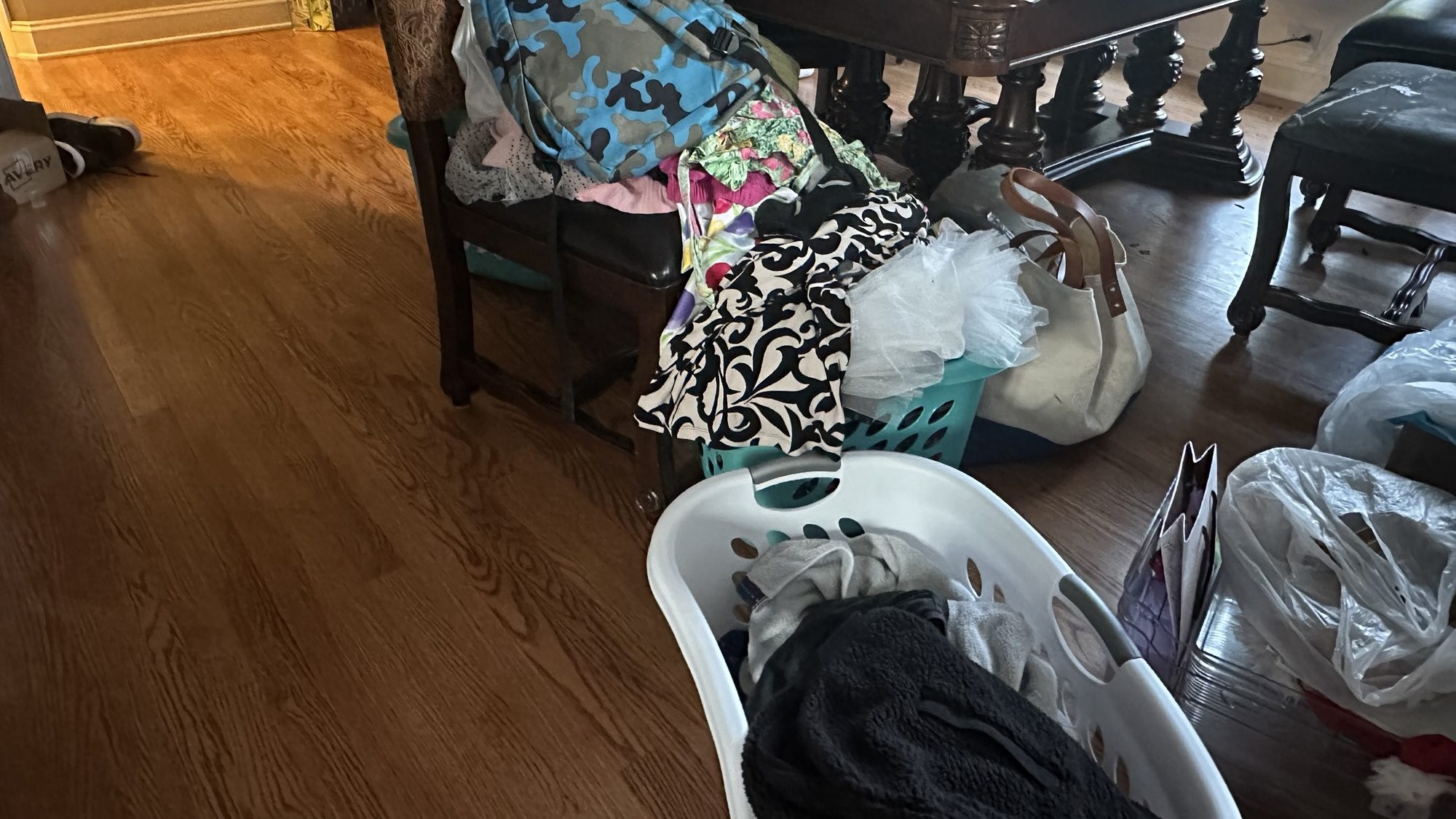
As the primary parent at home, only adult child of two live-in aging parents with various health concerns, and a golden doodle in a busy household, my chores are simply never ever ever close to being done. I choose to participate in part time work for multiple employers to retain some semblance of my career and to contribute financially to all we are keeping afloat. We volunteer our time in our neighborhood and within the community and are uber drivers for our kids’ activities constantly. My piles have piles and my to-do lists and notes litter the dining room table while my home office has quite a few tasks awaiting my divided attention as well.
The scariest pile is an area in my garage piled up with everything from the kids’ upcoming summer birthday parties to Christmas decorations (from our celebration in March this year when Mom was out of the hospital briefly) and Easter items that never made it back to the attic…. Yet is one of my favorite words to instill hope in my clients, but my husband is understandably quite fed up that that huge pile hasn’t received my attention…yet.
So we didn’t have any kids’ activities this past Wednesday evening and no plans so I shared with my husband (days in advance) my plan to spend a couple of hours making a significant dent in that pile by taking trips through the dining room and up two staircases to the attic storage area. I made an announcement to the kids at dinner sharing with them that there are some birthday surprises hidden in that area that I need to clean up and so they were to be in the basement, outside, or upstairs in their rooms, but not on the main floor while I was walking through with the items. I also reminded my husband how much he wants that area cleaned up and asked him to be the primary parent for 2 hours (which at our kids’ age involves being a bouncer in voice only- reminding them to stay out of temporarily “restricted” areas and breaking up battles between them). I sought personal space and uninterrupted focus and no one was more full of false hope that evening.
No sooner had a walked in the house with the first load but I found my youngest on her wobble board living her best life in the dining room while my husband clearly had no idea where she was and admitted such when I questioned him in irritation. I am the one who tends to be the most emotionally expressive and he tends to disengage, shut down, and retreat in the face of conflict. Later we used the tools that we know and have applied sometimes inconsistently during our 20 years of marriage and I shared how frustrated I felt when he chose to prioritize cleaning up unnecessary parts of the dinner mess in the kitchen (gotta put the food away because of the dog) that could have received attention later, over corralling the kids as I requested ahead of time.
He responded by letting me know that it is an unreasonable request for one parent to be expected to know where the children are while also cleaning up from supper. And my hair stylist chimed in right on cue that mothers everywhere are doing that every day. Nailed it.
If you have children or grandchildren, please do something special and encouraging for their primary parent and get to know more about the weight of the world on these individuals so often. And start ongoing conversations in your home about not only what your priorities are, but also how you’re going to attempt to handle everything when things that cannot be controlled (such as health issues of an aging parent or a challenging season in a child’s behavior) come up for you. Some have a partner or other support person to help share that primary load, others are running a one-person show whether they truly chose that or not.
My hair stylist’s understanding of my POV definitely made me smile and I may have laughed out loud a bit because I may have responded to my husband’s statement by saying that I could line up 20 mothers who would tell him that doing that very thing is a huge part of their day to day. What’s reasonable though does of course vary based on the individual, the situation, and the circumstances. While that may have been a bit of a cop-out on my husband’s part, which we have since chosen to put behind us, there are hundreds, maybe thousands of examples of responsibilities in life’s mental load and task load that are very real for the juggling in the sandwich generation.
How can we find better ways of sharing them I wonder?
Week 2 with us is in the books! Mom will be home post-most-recent hospitalization for 2 weeks on Monday!
Here’s a refresh on this week’s topics and some relevant questions: I ran through some lessons learned and tips related to Medical and Surgical teams and consulting specialties and shared potential issues related to getting a clear diagnosis while seeking effective treatment. I also shared some info regarding different types/levels of aftercare and spoke at length about our experiences with ways patient treatment compliance impacts admissions to aftercare. For discussion I am wondering what can be done to improve individual patient care from diagnoses, to treatment planning, to discharge with aftercare. I would also ask what can be done to assure that all aftercare facilities reach higher standards? Additionally I am very interested in knowing more about what happens to each medical facility, team, and provider when a patient is repeatedly readmitted, when errors are made, or when there is an infection post-procedure? Can managed care also offer some kind of incentives for hospitals, care teams, and providers who end up helping those who are medically complex to truly make progress? Can providers and their team members tell the patients and their families more about what managed care is doing that limits them? Might knowing more about the penalties the hospital and providers are facing bring a better understanding of the conditions they are operating under? Ultimately, how can providers and their teams better work as a team with the patient and patient’s loved ones to improve ultimate outcomes?
Fun Facts about the Founder and Family: We celebrated our family Christmas with blogger’s parents in March this year during a brief period of Mom being home from the hospital. The decorations stayed up from November to March and were both a bright spot while celebrating and a conversation starter when people stopped by. Mom’s favorite holiday is Christmas and her decorations, most of which were purchased in her 50’s and 60’s while she was an avid yard saler and thrift store treasure hunter. Her holiday colors are gold and forest green and her stately tree stands tall in the formal living room. Blogger decks the halls in blue and silver (much of which Mom found for her on her quests for steals and deals). When our large household comes together we are often
Key Takeaway: As always please use this week’s posts to start helpful conversations with your loved ones on these topics. You are also encouraged to begin thinking through who you will likely be advocating for and how it will look as you support them. Who can advise and support you through it? When it comes to aspects that you have some or total control over, how do you prefer to handle it? What does your loved one think?
Visit here often as we seek to Make It All Make Sense and at the very least support each other along the way.
I need to do a deep dive back through Mom’s hospital notes (In my spare time) to see how her patient refusals that I’ve heard so much about are documented. From the few I’ve taken a peek at, I am disappointed by how little detail is recorded about Mom’s stated reason for her refusal in many cases.
One stand out area of “self-limiting behavior,” as one Physical Therapist coined it at an intensive rehab Mom went to for therapy during our current 7 month journey, was declining PT during periods of abdominal discomfort or episodes of more intense abdominal pain. Mom also has terrible arthritis and now has bone on bone knees so walking around for her is excruciatingly painful. Medical professionals often agree that she is physically able to take more steps than she typically does, but as it is difficult to experience someone else’s pain directly, it’s just an area of significant difficulty that impacts her treatment. She is being treated for ongoing Adhesive Disease following a hernia repair and bowel blockage surgery. Along the way she has had a significant post-surgical infection during which she experienced so much pain that she could not tolerate food or liquids and they ended up putting her on TPN (total IV nutrition). We learned later that there was so much junk in the TPN that it caused her to gain weight at a time when her extra weight was a limiting factor as well.
Hospital Tip: No matter how uncomfortable your loved one feels, if they need PT and OT while inpatient I strongly advise them to participate when the PT and/or OT is in their room. Now PT and OT will not allow the patient to continue beyond what they truly can handle (for example if they become dizzy, they will have the patient sit down or if the patient’s BP is too high or too low for activity they are not going to push those limits). But you should know that not only are there far too few PTs and OTs (and I’m quite sure this is true for Speech Therapists and other specialties as well, but we do not yet have experience with a need for Speech support) working in regular inpatient hospitals to meet the need, but Also your loved one’s “refusals” are being counted and held against them.
What do I mean by that? Anytime your loved one is in need of some kind of aftercare for which the patient and family are not paying out of pocket (and probably even in cases of private pay the notes are being examined to determine appropriate level of care) the admissions staff at the skilled nursing centers, intensive rehabs, or home health agencies are thoroughly reading through your loved one’s chart. They are not just looking for diagnoses and needs that they may or may not be able to meet, but they are also noting what kind of patient your loved one has been. If they are repeatedly asking PT and OT to come back later when they feel better (pro tip: they don’t have time to come back as there is already not enough of them to go around so if they ever do do that for you, Wow, they are trying to go above and beyond for you with limited resources) they are not considered the ideal patient and are unlikely to be accepted at an intensive rehab (more on the differences between aftercare facilities in a future post). They are also reading all about how the patient cooperates or does not cooperate with taking medications and with complying with nurse recommendations and provider orders. Your loved one’s moods and rough days while going through health issues that have them in the hospital are part of the clinical picture of them that may or may not set them up for success when you are hoping to get them a bed at the nicer facilities with better care.
Early on when I was first learning about aftercare and how the facilities get a 1-5 star rating in PA from Medicare (It’s still not clear to me what all factors into that, but I think I just need more time for research), I called the only 5 star skilled nursing facility close enough to home that we hoped to have Mom go there for rehab. She had been rejected from this facility and at the time I did not know (and I think I really didn’t want to know) if that was because of her physical condition at the time or because Mom’s notes may reflect that she hadn’t been too keen on doing PT with abdominal pain (typically from ongoing partial bowel blockages) and her bone on bone knees. The facility had communicated back and forth with our hospital social worker and the social worker made me aware of the rejection. However, I thought that if this facility knew how dedicated we are as a family to bringing Mom home just as soon as she was just a little stronger and could get to know me by phone and see what a support system she has in her family and hear about all of the accommodations we have for her at home, they would surely reconsider admitting her. I was very wrong. Before I got much of a word in edgewise the admissions director snapped at me that Mom was reviewed by their whole team and she is rejected because she is at risk for readmission. No chance to explain who we are and what she has to come home to after a little support. I wonder if the hospital staff is considerate in the word picture they paint of the patient.
You may find your loved one rejected from multiple facilities and if other desirable ones who would normally accept your loved one do not have a bed or cannot accommodate something (such as a wound vac) that your loved one is currently managing with temporarily, you may find yourself choosing between home before your loved one is ready and a couple of 1 or 2 star facilities while the hospital is announcing that your loved one is medically stable for discharge and you’d better make that impossible decision right away. And if you don’t, your option is to appeal to Medicare or start paying the full hospital bills after noon the next day.
Key Takeaway for you: Talk about this with those you love. Demonstrating treatment compliance and noted refusals has proven very significant in opening and closing doors for Mom along the way. Think about how you will handle similar situations if you and your loved ones are faced with them.
Mom was in the hospital for about a week following a seemingly successful initial surgery (the initial surgery of this journey). She proudly shared and continues to share with providers and anyone who will listen how she managed to get through 75 years of her life with only wisdom teeth surgery. Now she sported a vessel loop closure, something new that allowed the incision area to be pulled together gently and gradually and after about a week post-surgery (and my difficult first encounter with who was to be Mom’s next surgeon) she was deemed ready for discharge to her very first experience with a Skilled Nursing Facility for rehab. It was all of our first experience with a real nursing home for anyone in my parents’ generation. Most recently I visited two of my husband’s grandparents in nursing homes and quite frankly I had moved my parents in in part to avoid setting foot in the awkward sadness that I have experienced in many of those facilities.
Unfortunately it quickly became clear that the staff at this first skilled nursing facility Mom was discharged to for rehab, did not appear to know how to care for her incision area as a whole, a process called “flossing” the vessel loops. The nurse practitioner who oversees the skilled nursing facility where Mom was admitted completely geeked out over the vessel loops saying he had not yet seen any and was very interested in getting to see what we assumed must be one of the latest ways to close a surgical incision in person.
Fast forward approximately 4 days later, Mom was right back through the ED with a fever and full-on infection of her Mesentery. Infections are a natural risk of surgery I have been reminded ad-nauseum and also the “flossing” logs from that initial facility show that if the nursing assistants or nurses or anyone else on staff there were flossing the vessel loops as often as they were supposed to be flossed they were not documenting doing so. I suspect the reason for the lack of flossing was that probably literally no one trained them to do so. I wonder if they were even all told about it, especially since Mom arrived on a Thursday night and was out the door with an infection by Tuesday. Between Dad and I we visited every day while Mom was in the initial skilled nursing facility. I introduced myself to the charge nurse admitting her, to the nurse practitioner, to the OT (was thrilled to see her there Friday morning, a fellow school district mom and friend), to every nurse, to the Social worker, to the head of PT. We stayed close and made ourselves visible (which I recommend that you do), but there was still what I would refer to as a shortage in services particularly over the weekend.
Thankful Mom got a bed there when she did at a facility rated with 3 Medicare Stars. The 4 star facilities and one 5 star would not or could not take her for various reasons which I will describe further in future posts. Keep at the forefront of your mind that if your loved one needs aftercare it is not always easy to come by and the fact that it’s complicated is a gross understatement, especially in the case of a medically complex situation.
I am certainly not stating that the Mom’s first 4 days at a skilled nursing center or anything that happened there were to blame for the roaring infection she went back into ED with. Mom’s case is medically complex and the makings of an infection could have started during or soon after the surgery or during her week of recovery in the hospital and we will never know the cause for sure. However, what I am saying is that I strongly suspect that the surgical team who placed those vessel loops and then monitored Mom through discharge did not adequately make sure they communicated how to floss those vessel loops to the actual staff members that were going to be flossing them. Again, correlation does not mean causation, but what might be on your loved one’s discharge plan that is not being carried out by a third party caregiver correctly and could this be because of a lack of thorough communication?
Hospital Hints:
Maybe things are missed every day on discharge plans that are of no consequence, but I urge you as your loved one’s advocate to familiarize yourself with the discharge plan and how each direction is to be carried out and by whom and follow up to make sure things are being carried out as intended.
Also, did you know that hospitals and physicians can be penalized and sometimes not paid by Medicare and other managed care companies if their patients end up with an infection or if they are readmitted for that or another reason? I am just learning this and know very little about it as of yet, but what I will tell you is that for one month a team of surgeons and their residents did not miss a beat repeatedly insisting that Mom’s diagnosis was “inflammation of the messentery” and Never Ever Ever Infection. Her admission paperwork in the ED says sepsis and she was being treated prophylactically with antibiotics as she had a fever and an elevated white count. For days, weeks, and ultimately over a month they could not get the infection under control and involved Infectious Disease who was treating my mom with multiple antibiotics, but as the family member when I asked if my mom had an infection, the surgical team always said “no inflammation.” Multiple surgical residents and surgical attending physicians at the small hospital said that for them to diagnose my mom with an infection they would have to open her back up surgically and take out a sample of the inflamed area and send it to pathology for a test to officially say she had an infection. From steroids or other autoinflammatory meds to muscle relaxers and GI medications, and even some pain meds they prescribed one thing after another to try to get my mom’s pain and other symptoms under control. But I will never forget how they looked me straight in the eye for a month and spoke to me by phone for a month and told me that my mom had inflammation, but no infection while she was being treated with antibiotics by Infectious Disease. It made me wonder how in the world I could trust anything else they said. I certainly tried and some providers and residents were more attentive than others as they attempted for weeks to find the right plan of care, but that ridiculous claim of inflammation felt so very false so just know that that’s something out there that you might encounter. Someone who works for that small hospital told me they get in trouble if they call it an infection. Someone else told me the protocols have something to do with preventing the overdiagnosis of infections or incorrect diagnoses of infections as it was something going on during Covid. But what I will remember forever is feeling so in the dark while surgeons I’d hoped to trust and their residents kept making statements that felt like gaslighting.
Pro (amateur trying to become pro) Tip: Talk to many different people in the medical field who you know in your personal life (if you are blessed to know them) and ask lots of questions. Ask for their recommendations, ask for their point of view, and ask them which questions you should be asking the doctors, which ones they would ask if it was their loved one. If things get medically complex show your loved one’s scans to those who are trained to read them and continue to gather lists of questions to bring to the treatment team.
Hospital Hint: Leave a Voicemail with questions for the RN Case Manager first thing in the morning if that individual appears to care
I am trying to recall when I learned that Mom was not only assigned a social worker/case manager/aftercare planning extraordinaire, but also was assigned an RN Case Manager. I am deeply grateful that this position exists as it is a registered nurse (someone clinical who understands at least a significant amount of what’s going on medically) who participates in the medical team meetings regarding your loved one’s care. Get this person’s business card or jot down their phone number and extension ASAP. They are able to both send direct messages to the providers through a staff chat feature AND they sit in the treatment team meetings. If anyone is going to share your questions with the providers AND get an actual response, it seems it will be them. Our first RN Case Manager taught me that Mom did not have a Medical Team treating her, she had a Surgical Team treating her. She provided me with a number of correct terms in a supportive, respectful way.
My understanding is that the bedside nurse, case workers, PT/OT, residents, and others have some access to the chat with the doctors, however the doctors (especially the surgeons) can be slow to respond. It is understandable that they are busy and the surgeons are often in surgery, but having a Nurse Practitioner or Physician’s Assistant on the team who can receive calls from family members and advocates is incredibly helpful and that option is not put into practice enough. During one lengthy hospital stay at the smaller hospital I did get a Nurse Practitioner who works with the surgeons to call me a time or two, but I don’t remember receiving helpful answers from those calls. The first RN Case Manager we had, however, communicated every question I had to the team and called me back with every answer she got. There was a time I was leaving her a message nearly daily for weeks with questions I came up with by tirelessly texting wonderful people I know who work in the medical field. That was my best access to a way to communicate my questions to the doctors during a time when solutions from them were far too few and getting calls directly from the surgical team were a near impossibility (I will describe exceptions to that as well as other solutions we came up with in another post). If you think you are going to ask an inpatient provider a question directly without quite a bit of effort, definitely manage your expectations about that (Tips on this another day).
Unfortunately we were not assigned that original RN case manager with every readmission to the smaller hospital and the second one we had was more no-nonsense. She was courteous in asking to speak freely and I encouraged her to do so. Her recommendations surrounded accepting the readmits as the new normal and she described ways to learn how to stay home longer until things are extra emergent in hopes of making it to daytime hours and potentially seeking outpatient scans during daylight hours and maybe even a direct admission. She did not return calls very often and did not seem to want to pass on my questions as readily, attempting to talk me out of any suggestions I made about the surgeons being held accountable for finding a solution for my mom or directly referring her out. Also unfortunately during our most recent readmit to the smaller hospital, our original Case Management RN was back on Mom’s team, but she was colder and less involved (it seems there are penalties for readmits and after a while the hospital shows you they want to be rid of you, even if they have not resolved your loved one’s problem).
Also less than ideal, at the larger hospital I was not given the phone number for the RN whose title I believe was Care Coordinator. The bedside nurse who went over Mom’s discharge instructions said he stands in the back, but rounds with the treatment team. Interestingly enough, it seems he may have been in charge of our botched home health admission most recently and never reached out to our family at all. At the larger hospital there was no EDD until day of and I was asked to come get my mom. The smaller hospital gave much better notice. Wondering how the larger hospital would have handled it if I said to them I could not come that day or that I had one brief conversation with the social worker and none with the RN Care Coordinator and was never given any advanced notice that the discharge was going to be that Monday.
Just know that these are things that happen and that overall you are your loved one’s advocate. If you are fortunate enough you can receive help from some of the hospital staff, but it seems to be the exception quite often rather than the rule. But if you are seeking a line of communication beyond calling the bedside nurse (who will often help, but who is also often very busy with other patients), try the RN Case Manager with your medical questions as they can both put the questions in the chat to the doctors (so can the bedside nurse), but they can also communicate your questions and concerns at the treatment team meeting they attend. Leaving voicemails for them is one solid way to go as you cannot leave a voicemail for the doctors.
It seems fitting to launch this blog exactly 7 months after my Mom’s initial emergent surgery on October 19, 2024. She was discharged from her second hospital system this evening and we’re home preparing for a new liquid diet and awaiting an elective surgery we hope to schedule in 2-3 months. After almost 7 months of going through what can only be described as “a whole lot,” we were directly transferred to a hospital we hope is better equipped to handle mom’s medically complex case, while remaining truly aware that so many other patients and their families have seen the depths of diagnoses and treatments we hope to never experience.
This blog is to be a forum for the caregivers, the advocates, the support persons, many of us who find ourselves navigating the sandwich generation. At the moment I find myself just a hop, skip, and a jump ahead of where I was 7 months ago, clueless in terms of how to advocate for my mom in the inpatient hospital system after her first emergent surgery (her only surgery beyond having her wisdom teeth out at age 23 on her first wedding anniversary). As I frantically texted everyone I knew who has ever worked in a hospital, a dear friend’s husband (who was a guiding light more than once when I was at my wit’s end and did not know what move to make next) mentioned to her, “Maybe she doesn’t know how inpatient works,” and my dear friend mentioned that to me.
It occurred to me that even after I managed to advocate for my dad in a different hospital following quadrupal bypass surgery and through his recovery a few years ago (with reassurance from this same caring couple and hours of support and education by phone from my Amazing cousin who worked for years as an RN with patients recovering from surgery), I still didn’t know how to play the game that is the inpatient hospital system. As a family member and an advocate there was not clear direction in a situation of medical complexity who to go to within the hospital for guidance.
So in my quest to figure out how inpatient works from one hospital to another and to support each one of you as you seek the best care for your loved ones, I am writing what I know from our experiences thus far and what I hope to find out. It is my wish that you will find helpful information here and that you will share your experiences so that we all learn and grow as advocates for the ones dearest to us. May patient care and outcomes improve as we learn to ask better questions, to seek better answers, and to come alongside those we love to help them to be seen.
And may we feel seen here.
Hospital Hint: It seems there’s no such thing as a Patient Advocate in our brief experience with inpatient stays. I look forward to sharing this week what I know so far about those in roles that seem sort of patient-advocate adjacent. They sound like they are in the neighborhood of being supportive of the patient and family, but they have very specific roles with the hospital in mind first and it appears they may be burdened with too many cases to effectively provide desperately needed guidance to patients and their support people.
These days every staff member from transport to bedside nurse is encouraged to be an advocate, yet, in our experience, no one’s main job was to truly come alongside the patient and family. And those who served in those roles seemed to have very little power, pull, or sway or claimed powerlessness frequently.
Where my mom was admitted there was plenty of info around on posters about how discharge begins at admission so I asked the bedside nurse on a Sunday evening approximately 24 hours after emergent surgery who the social worker, case worker, discharge planning person was? I didn’t know the term. Her response was that Nothing gets done on the weekends and no one was yet assigned to my mom. I asked if I could have a general phone number where I could leave a message to describe our family’s situation and she wasn’t aware of how I could get that number.
In this week’s posts I’ll introduce you to our experience with the following positions: Patient Experience, Case Workers, and RN Case Managers



 Sandwiched Support